Did you receive a call from a telemarketer or from a private or blocked number and can’t tell who called you? If your first thought is, “Who called me?” you aren’t the only one. Everyone gets suspicious calls. But how do you deal with calls that aren’t only annoying, but also potentially dangerous?
If someone’s phone is ringing, most people’s first instinct is to answer the phone call. However, this may not be the best choice as spammers may be able to scam you with a few simple tactics.
National Cellular Directory’s National Fraud Trends review of 2024 FTC data shows how differently fraud can hit each state. For example, reported losses reached almost $1.7 billion in California, more than $104 million in Alabama, and nearly $27 million in Alaska. Different totals, same lesson: an unknown call deserves a little caution.
Americans still receive billions of robocalls each month, and the financial damage behind suspicious calls is getting harder to ignore. The FTC reported that consumers lost $12.5 billion to fraud in 2024, while imposter scams alone accounted for 845,806 reports and $2.95 billion in reported losses. Additionally, not only can your caller be a scammer, they could also be a telemarketer or perhaps even a stalker.
That national trend did not slow down. According to newer FTC data on fraud and imposter scams, consumers reported about $16 billion in fraud losses during 2025, including roughly $3.5 billion from imposter scams.
Sometimes it’s easy to know who’s calling: just check your Caller ID for their details.
However, if your Caller ID isn’t displaying a name for the phone number in question, there’s another method that makes it easy to find out who is calling you. An online cell phone directory can help you research the number before you decide whether to respond.
In this article, I will cover the following important questions:
These questions are all important to ask as the number of spam, robocalls, and telemarketer calls continues to rise.
Who Is Calling Me from a No Caller ID Number?
Indeed, there are lots of calls we get from these unknown callers.
Calls can come from phone tricksters, friends, exes, business competitors, and more.
These callers can be cunning, sometimes trying to get under your skin to scam you out of your hard-earned money. Regardless of the type of call you receive, the truth remains: fake calls are an invasion of privacy and a threat to your security.
If no phone number appears at all, a reverse lookup cannot search it. Let the call go to voicemail, use your carrier’s call-protection tools, and save screenshots, voicemails, dates, and times if the calls become threatening or persistent.
Read our guide: How to do a free reverse cell phone lookup
Need to know right now who is calling you? If you’re asking, “Who is calling me from this number?” enter the phone number in question in the box below.
Pro Tip: A reverse phone lookup can show possible information connected to a number, but it cannot prove who actually placed the call. Caller ID can be spoofed, and phone numbers can be reassigned. Compare the report with information you already know before taking action.
National Cellular Directory is not a consumer reporting agency, and its information cannot be used to determine eligibility for credit, insurance, employment, housing, or another purpose covered by the Fair Credit Reporting Act.
Did a Telemarketer Just Call Me?
Telemarketing has been around for a long time. Because many of these calls are unsolicited, people often feel annoyed or frustrated when they receive unexpected calls from telemarketers.
It’s understandable to think, “Whose number is this?” when an unknown number is calling, as no one wants to deal with a telemarketer. After all, a telemarketer’s practices can sometimes be unreasonable, harassing, and impolite.
For example, telemarketers are known to call late during the evening or at an odd hour toward the beginning of the day, refuse to identify themselves, make repeated calls even after they were asked not to call back again, and engage in questionable practices.
Then you start to wonder, is this a telemarketer or something worse, like a scammer?
Due to the volume of complaints about telemarketing, lawmakers created stronger consumer protections and rules for telemarketers.
Congress enacted the Telephone Consumer Protection Act in 1991, establishing restrictions on telemarketing calls, autodialers, prerecorded messages, and other telephone solicitations.
Key TCPA Facts
- Consent matters – Marketing calls or texts made with an autodialer or prerecorded voice generally require prior express written consent. Consent should be clear, tied to a specific purpose, and not required as a condition of purchase.
- Calling hours and identification – Organizations should contact consumers only between 8 a.m. and 9 p.m. local time, display accurate caller ID information, and clearly identify themselves and provide contact details.
- Texts count too – For TCPA purposes, marketing text messages are generally treated like calls.
- Do Not Call requests must be honored – Businesses should suppress numbers on the National Do Not Call Registry, maintain an internal Do Not Call list, and process opt-out requests.
- Records matter – Organizations should document consent and Do Not Call requests and retain relevant records. Wipfli notes that Do Not Call records should be kept for at least five years.
- Penalties can add up quickly – TCPA claims may seek $500 per violation and up to $1,500 for a willful violation.
Wipfli’s May 2026 Beginner’s Guide to the TCPA provides more detail on these requirements. Legitimate telemarketers generally must follow applicable rules. Scammers, unsurprisingly, may ignore them.
Key Events
In 2003, the FTC launched the National Do Not Call Registry, giving consumers a simple way to opt out of most telemarketing sales calls with a single registration. Calls from political organizations, charities, survey organizations, and companies with which you have an established business relationship may still be allowed under federal rules. Learn more about the exceptions from the FTC.
The Do-Not-Call Improvement Act of 2007 made registrations on the National Do Not Call Registry permanent. Today, once you register your number, it stays on the registry unless you remove it or the number is disconnected and reassigned.
The FTC makes an important distinction about the National Do Not Call Registry: it can reduce sales calls from companies that follow the law, but it does not block calls and will not stop scammers who ignore the rules.
Telemarketing regulations are intended to protect consumers from unsolicited and unwanted calls.
That does not mean every telemarketer follows the law or that deceptive organizations will identify themselves honestly.
If these calls continue, ask the caller to stop and report unwanted sales calls through the National Do Not Call Registry. If the call involved a scam, financial loss, or information about a suspected scammer, report it through the FTC’s fraud reporting site.
Why Is It Essential to Find Out Who Called?
Fake calls are a threat to everyone. There are two significant reasons why finding out who called is essential.
Reason #1. These calls can slowly erode the trust between you and your smartphone. What was once a helpful device suddenly feels like a source of stress.
It’s frustrating to see unfamiliar numbers flashing across your caller ID, and almost instantly, the same questions start running through your mind:
Who could be calling right now?
Would it be a good idea for me to answer?
Could it be a robocall?
What if it’s an annoying telemarketer?
Reason #2. If you are not careful, some unknown calls can lead to serious financial or personal harm.
Repeated calls may be illegal when they are made with the intent to abuse, threaten, or harass someone. The exact rules depend on the circumstances and applicable law.
Federal law addresses certain repeated or threatening calls made with the intent to abuse, threaten, or harass. Scam calls may also try to trick you. Warning signs can include:
Persistently making your phone ring.
Making disgusting remarks, proposals, or solicitations.
Hiding their identity while making threats or repeated unwanted calls.
Making repeated phone calls, especially after you have asked not to be contacted again.
Attempting to obtain your personal or private data by phone.
Pretending to be someone they are not.
Trying to distinguish who called you from a blocked telephone number is no simple accomplishment.
This can be especially frustrating in telephone harassment situations, as few solutions immediately put an end to the annoying calls.
In many cases, the best step is to find out who called you and how to stop the calls if they continue.
How Can You Stop Unwanted Callers from Calling You Again?
Rule #1: Block Each Number One by One
If a specific number keeps calling, you can block it directly from your phone. Blocking stops calls and messages from that number from reaching you normally, although the exact behavior varies by device and carrier.
Before blocking, however, you may want to verify information about the number, especially if you’re unsure whether it could be from a legitimate business, delivery service, or someone you know.
A quick online search or reverse phone lookup can help you decide.
How to Block a Caller on iPhone and Android Phones
Most smartphones make it easy to block unwanted callers, although the exact steps vary by device. If you need help, follow Apple Support’s current iPhone instructions or Google Phone Help’s steps for blocking numbers on Android devices. Newer iPhones may also let you screen unknown callers, silence them, or filter suspected spam, depending on your software and settings.
Rule #2: You Can Use Your Carrier’s Protection Tools
Most major wireless carriers offer free tools to help identify or block spam and scam calls. Some advanced features may require a paid subscription.
AT&T ActiveArmor: AT&T's free ActiveArmor app can help identify and block suspected spam and fraud calls for customers with an AT&T wireless plan. Additional features are available with the paid version.
T-Mobile Scam Shield: T-Mobile's Scam Shield helps identify suspected scam calls and can automatically block many of them before your phone rings when Scam Block is enabled.
Verizon Call Filter: Verizon's free Call Filter service identifies suspected spam, automatically blocks many high-risk spam calls, and lets you report unwanted numbers. A paid version adds features.
Rule #3: Consider a Third-Party Call-Blocking App
These services rely on regularly updated databases of spammers and fraudsters to block unwanted calls. By continuously analyzing new scam patterns and user reports, they can identify emerging threats and help keep your phone communications safer.
Rule #4: Enable the Do Not Disturb Option to Allow Calls Only from Your Contacts
On both Android and iOS, you can enable Do Not Disturb mode to allow calls only from people and organizations in your contacts. This is an extremely effective way to tackle robocalls, but you’ll likely miss some calls you might have wanted to answer.
Calls that are not allowed through may be silenced or sent to voicemail, depending on your phone, carrier, and settings.
How to Search for a Phone Number at No Cost?
Sometimes you just want to know who is calling without spending a dime. Luckily, there’s a simple option that doesn’t cost anything: the National Cellular Directory free daily safety and verification search window.
During our free daily lookup window, registered members can currently run two premium reverse phone or name searches at no cost. That means you can search the cell phone directory by name free of charge during the designated window. It is a limited-time window each day, but it gives you access to premium search reports without purchasing an individual report.
Here’s how it works:
- Create a free account with National Cellular Directory.
- Wait for the short daily window when free searches are allowed.
- Enter the phone number and see what comes up.
Even if the number doesn’t show up, this is a quick, risk-free way to check before deciding to answer, block, or ignore the call.
Pair this with the other tips in the previous section, such as blocking numbers and using carrier tools, and you’ll be in much better control of who gets through to your phone.
You can also check the current free lookup details here before starting.
Pro Tip: Learn how National Cellular Directory collects and matches data.
What Is Neighborhood Spoofing?
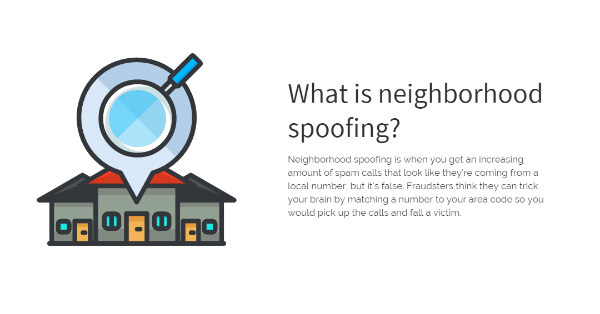
Neighborhood spoofing is when a spam call appears to come from a local number even though the displayed number may be false.
It is a tactic scammers use to make a call look local by matching the recipient’s area code, or even the first few digits of their phone number, in hopes that the call will be answered.
But thanks to technology, there are apps and other tools that help identify neighborhood spoofing.
The FCC defines caller ID spoofing as deliberately falsifying the information sent to your caller ID display to disguise the caller’s identity. That means a familiar-looking number is not proof that the caller is nearby—or even connected to that number.
Are Telemarketers Still Calling? Attempt These Three Steps
Tip #1. If You Answer, Keep the Call Short
Risk Level: Low to moderate risk
Best Practice: Do not answer questions or confirm personal information. If the caller appears to be a legitimate telemarketer, say, “Please put me on your Do Not Call list.” Repeat that sentence if they keep talking, then end the call.
If the caller asks for a password, verification code, gift card, cryptocurrency payment, wire transfer, or remote access to your device, hang up. Contact the organization using the number on its official website, app, statement, or the back of your card.
Tip #2. Ask to Speak to a Supervisor
Risk Level: Low risk
Best Practice: If a legitimate telemarketer calls again after you have instructed them to stop, the previous representative may have failed to add your number to the company’s internal Do Not Call list.
Ask to speak with a supervisor or administrator and have them confirm that your number is added to the list.
Tip #3. Report to FTC
Risk Level: Very low risk
When the steps above don’t work, report unwanted sales calls to the FTC through the National Do Not Call Registry. While the FTC may not resolve every individual complaint, reports help them track and take action against illegal telemarketing and scam activity.
You can also file an unwanted-call or spoofing complaint with the FCC. Save screenshots, voicemails, dates, times, and the displayed number before deleting anything.
What Does It Mean When My Phone Number Shows Up on My Caller ID?
A call displaying your own number is usually an example of caller ID spoofing. A scammer may falsify the displayed number to attract your attention or persuade you to answer.
Obviously, the call isn’t from your own phone number, which might make you wonder, “Who’s calling me?”
Scammers can use spoofing technology to make your own phone number appear on your caller ID.
So, if your own phone number is calling you, just don’t answer it.
We Live in a Confusing World of Technology
I hope this piece has helped you understand how to deal with unwanted calls. It can be easy to fall victim to a phone scam if you aren’t careful.
Staying aware of common tactics and tricks used by scammers and taking simple precautions can help protect your personal information. When in doubt, it’s always safer to hang up and verify the caller through a source such as an online phone directory before responding.
The most important thing to remember is that urgency is a scammer’s favorite tool. You do not have to make a decision while someone is pressuring you on the phone. Hang up, breathe, and verify. Yeesh. Your money and personal information can wait a few minutes while you make sure the caller is real.